Vietnam Unveiled: A North-to-South Odyssey Through the Dragon's Top Treasures
Discover the best Vietnam itinerary with our 3-week north-to-south guide. Explore Halong Bay, Hanoi, Hoi An, Phu Quoc, Mekong Delta & more. Insider tips on transport, weather, routes, and must-see spots for an unforgettable Vietnam trip.

Vietnam Unveiled: A North-to-South Odyssey Through the Dragon's Top Treasures
By The Global Roamer December 30, 2025
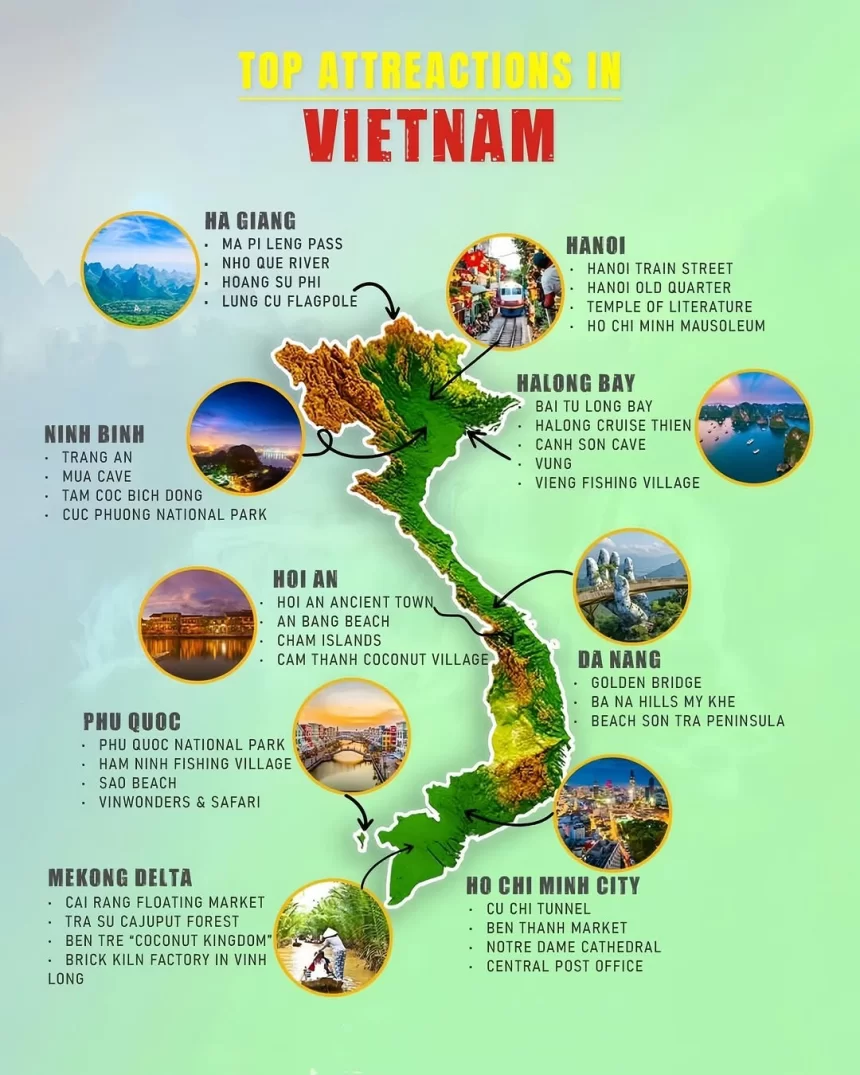
Vietnam, the S-shaped ribbon of a nation stretching over 1,600 kilometers from the misty karsts of the north to the sun-drenched deltas of the south, is a traveler's dream woven from emerald rice terraces, ancient pagodas, and bustling street markets. As a country where French colonial elegance meets indigenous hill tribe traditions, and where limestone pinnacles pierce the sea like the spines of a slumbering dragon, Vietnam defies easy categorization. Drawing from the iconic map of its top attractions—highlighting everything from Ha Giang's vertigo-inducing passes to Phu Quoc's pristine beaches—this guide crafts a comprehensive north-to-south itinerary for intrepid explorers. Whether you're a first-time backpacker or a seasoned wanderer, we'll delve into each destination's must-sees, optimal weather windows, seamless transportation routes, insider tips, and hidden gems to elevate your journey beyond the ordinary.
This 3-week blueprint assumes a mid-range budget (around $50–$100 USD per day, excluding international flights) and prioritizes sustainable travel—think eco-cruises and community-led tours. Vietnam's domestic network is efficient, blending high-speed trains, affordable flights, and scenic buses. The best overall window? March to April or September to November, when the weather is mild nationwide, crowds are manageable, and festivals like Hanoi's Tet (Lunar New Year) add cultural sparkle. Pack light layers, rain gear for shoulder seasons, and a sense of adventure. Let's trace the dragon's spine.
Northern Vietnam: The Rugged Frontiers of Ha Giang and Hanoi
Vietnam's north is a symphony of jagged peaks, ethnic diversity, and colonial charm—ideal for those craving raw landscapes and urban buzz. Start here, as flying into Hanoi's Noi Bai International Airport (HAN) is the most straightforward entry point from major hubs like Bangkok or Seoul.
Ha Giang Province: The Extreme North's Untamed Beauty
Perched on the border with China, Ha Giang is Vietnam's wild frontier, a UNESCO-recognized geopark where Hmong and Dao hill tribes cultivate terraced fields that cascade like jade waterfalls. The region's star is the Ha Giang Pass, a serpentine road twisting through limestone cliffs at elevations up to 1,000 meters—often called the "King of Roads" for its dramatic hairpin turns and panoramic vistas of plunging valleys. Nearby, the Ma Pi Leng River carves a turquoise gorge below the pass, perfect for a half-day hike or motorbike ride to spot golden eagles soaring overhead. Don't miss Hoang Su Phi Pole (rice terraces), a UNESCO site blooming in rippling greens from September to October, or the Lung Cu Flagpole, Vietnam's northernmost point, where a massive red-star flag flutters atop a hilltop viewing platform overlooking China.
Weather and Best Time: Cooler and drier from September to April, with highs of 20–25°C (68–77°F) in spring; summers (June–August) bring heavy rains that can muddy trails. Winters dip to 10°C (50°F), so layer up for misty mornings.
Getting There and Around: From Hanoi, hop on a 6–7-hour sleeper bus from My Dinh Station (200,000–300,000 VND/$8–12 USD) operated by companies like Sapa Ethnic or Ha Giang Bus—book via 12Go.asia for reliability. Once in Ha Giang City, rent a motorbike (150,000 VND/day) for the 300km loop road (permit required, $10 USD). For safety, join a guided tour with Puluong Canai Eco Lodge for off-road jeeps. Route tip: Tackle the pass clockwise to avoid afternoon fog.
Insider Tips: Stay in homestays like Cong Troi Village for Hmong cooking classes (try thang co horse stew). Hydrate heavily at altitude, and respect ethnic customs—no photos without permission. Allocate 3–4 days; it's remote, so stock up on Hanoi snacks.
Hanoi: The Heartbeat of the North
Hanoi's chaotic energy—where cyclos weave through French boulevards and pho vendors stoke dawn fires—sets the cultural tone. The map spotlights Hanoi Train Street, a narrow alley where Vietnam Railways' scarlet engines rumble inches from café tables (visits best at 3–4 PM when trains pass; 50,000 VND entry fee). Wander the labyrinthine Hanoi Old Quarter, a 36-street maze of silk shops, silver stalls, and banh mi carts—bargain hard, but smile. The serene Temple of Literature (Vietnam's first university, built 1070) offers Confucian courtyards and ancient stelae amid koi ponds. End with the somber Ho Chi Minh Mausoleum, a marble edifice housing "Uncle Ho" (open mornings, free but queues form early).
Weather and Best Time: Mild October–April (15–25°C/59–77°F); avoid June–September monsoons.
Getting There and Around: Airport taxi to Old Quarter (350,000 VND/14 USD) or Grab app (cheaper). Use the hop-on-hop-off bus (150,000 VND/day) or rent a bicycle for the flat streets. From Ha Giang, reverse the bus route.
Insider Tips: Catch a water puppet show at Thang Long Theatre (200,000 VND). For street food, hit Quan An Ngon for curated hawker bites. Stay in a boutique hotel like Hanoi La Siesta amid the Quarter's buzz.
Northeast Escapes: Halong Bay and Ninh Binh
These karst wonderlands, just 2–3 hours from Hanoi, showcase Vietnam's geological poetry—limestone towers rising from misty bays.
Halong Bay: The Bay of Descending Dragons
A UNESCO World Heritage site with 1,600 islands, Halong's emerald waters beg for a cruise. Opt for Bai Tu Long Bay for quieter vibes than the main bay, or a Halong Cruise on Paradise or Indochina Sails (2–3 days, $200–400 USD including kayaking). Explore Canh Son Cave and Vung Son Cave, dripping with stalactites, then drift to the stilted Vung Fishing Village for squid fishing at dusk.
Weather and Best Time: October–April for calm seas (20–25°C/68–77°F); typhoons hit July–September.
Getting There and Around: 3.5-hour shuttle from Hanoi (included in cruises, $20 USD standalone). Cruises handle all onboard transport.
Insider Tips: Choose eco-certified operators to minimize plastic waste. Pack motion sickness meds; sunrise tai chi on deck is magical.
Ninh Binh: The Inland Halong
Dubbed "Ha Long on land," Ninh Binh's rice paddies frame sheer cliffs. Row a sampan through Trang An's UNESCO caves and pagodas (150,000 VND/boat). Summit Mua Cave for 500 stone steps, rewarding 360° views. Cycle to Tam Coc Bich Dong, a riverine trio of rice fields, caves, and temples. Venture to Cuc Phuong National Park, Vietnam's oldest reserve, for primate spotting and butterfly valleys.
Weather and Best Time: February–May (dry, 25°C/77°F); floods August–October.
Getting There and Around: 2-hour train from Hanoi (100,000 VND) to Ninh Binh Station, then taxi to sites. Rent bikes (50,000 VND/day) for paddy trails.
Insider Tips: Visit mid-week to dodge tour groups. Homestay at Tam Coc Rice Fields Resort for farm-fresh meals.
Suggested Route: Days 1–2: Ha Giang loop. Days 3–5: Hanoi immersion. Day 6: Halong overnight cruise. Day 7: Ninh Binh exploration. Total north leg: 7–8 days.
Central Vietnam: Hoi An's Lantern Glow and Da Nang's Bridges
Fly south (1.5 hours, $30–50 USD on VietJet) to Da Nang's international airport (DAD) for the central coast's blend of beaches and history.
Hoi An: Ancient Town and Coastal Charms
This lantern-lit UNESCO gem pulses with silk tailors and riverside cafés. Stroll Hoi An Ancient Town's Japanese Covered Bridge and assembly halls (120,000 VND ticket covers five sites). Unwind on An Bang Beach, a laid-back stretch for surfing lessons. Boat to Cam Thanh Coconut Village in the Thu Bon River for basket-boat spins amid palm groves.
Weather and Best Time: February–August dry season (25–30°C/77–86°F); rains September–January.
Getting There and Around: 30-minute taxi from Da Nang (300,000 VND). Walk or cycle the flat town; ferries for village trips.
Insider Tips: Get a custom ao dai fitted (from $50 USD). Full moon nights ignite 1,000 lanterns—book riverside dinners early.
Da Nang: Modern Marvels and Hillside Wonders
Da Nang's skyline gleams with the Golden Bridge, a 150m hand-held walkway atop Ba Na Hills (cable car access, 900,000 VND combo ticket). Ascend Ba Na Hills for French village replicas, fantasy parks, and misty forests. Relax on My Khe Beach along Son Tra Peninsula, a monkey-filled headland with Linh Ung Pagoda's 67m Lady Buddha.
Weather and Best Time: Same as Hoi An; typhoon-prone fall.
Getting There and Around: Airport hub; Grab rides everywhere (50,000 VND short hops). Sun World Ba Na shuttle from city center.
Insider Tips: Hike Son Tra's trails at dawn for fewer crowds. Seafood at My Khe: grilled squid with nuoc mam.
Suggested Route: Days 8–10: Da Nang base, day trip Ba Na. Days 11–12: Hoi An tailoring and beaches.
Southern Vietnam: Phu Quoc's Paradise and the Mekong's Waterways
Domestic flight to Phu Quoc (2 hours from Da Nang, $40 USD) or HCMC, then ground south.
Phu Quoc Island: Tropical Escape
Vietnam's largest island is a diver's haven. Trek Phu Quoc National Park's 300 sq km of coral reefs and mangroves. Visit Ham Ninh Fishing Village for fresh seafood auctions at dawn. Lounge on powdery Sao Beach, or thrill at VinWonders & Safari, Asia's largest theme park with water slides and big cat enclosures.
Weather and Best Time: November–April (25–30°C/77–86°F, dry); monsoons May–October.
Getting There and Around: Fly into Phu Quoc Airport (PQC); taxis or scooter rentals (200,000 VND/day). Park shuttles included.
Insider Tips: Snorkel sustainably with local operators. Sunset cocktails at Rory's Beach Bar.
Mekong Delta: The River of Nine Dragons
This fertile basin teems with floating life. Dawn at Cai Rang Floating Market, Can Tho's chaos of pineapple boats and noodle soups (join a 6 AM tour, $20 USD). Paddle through Tra Su Cajuput Forest's flooded canals. In Ben Tre, dubbed the Coconut Kingdom, tour groves and candy factories. Peek at a Brick Kiln Factory in Vinh Long for terracotta artistry.
Weather and Best Time: Dry November–April (28–32°C/82–90°F); floods July–November.
Getting There and Around: From HCMC, 3-hour bus to Can Tho (150,000 VND). Boat tours essential; bike add-ons for villages.
Insider Tips: Overnight homestay for com tam breakfasts. Support women-led co-ops.
Ho Chi Minh City: Saigon's Urban Pulse
End in the south's dynamo. Haggle at Ben Thanh Market for spices and knockoff shades. Admire the rose-hued Notre Dame Cathedral and Gustave Eiffel's Central Post Office. (Cu Chi Tunnels day trip optional, 1 hour bus.)
Weather and Best Time: Dry December–April (25–35°C/77–95°F); rains May–November.
Getting There and Around: Tan Son Nhat Airport (SGN); the metro, opening in 2025 eases traffic. Cyclos for Quarter jaunts.
Insider Tips: Rooftop bar at Chill Skybar. Street art tour in District 2.
Suggested Route: Days 13–14: Fly to Phu Quoc, beach hop. Day 15: Fly HCMC. Days 16–17: Mekong overnights. Days 18–20: HCMC and Cu Chi. Fly out.
Final Roamer's Notes: Sustainable Steps and Essentials
Vietnam's allure lies in its resilience—post-pandemic tourism hit 12 million visitors in 2025, up 20%. Travel green: Use reusable bottles, choose carbon-offset flights via Vietnam Airlines, and tip locals fairly (10–20%). Visa: e-Visa for 90 days ($25 USD). Health: Vaccinations for Hep A/B, malaria tabs for rural north. Currency: VND, but USD widely accepted.
This north-to-south path covers 2,000+ km, blending adrenaline with serenity. As the map reminds us, Vietnam isn't a destination—it's a transformation. Where will your roam take you next? Share in the comments. Safe travels, wanderers.